1.-¿QUÉ ES LA HERENCIA?
*Es el conjunto de caracteres fenotípicos y del genoma que transmite un individuo a la descendencia.
* Es la transmisión genética de caracteres normales o patológicos de los ascendentes a los descendentes. Constitución genética de un individuo.

http://es.wikipedia.org/wiki/Herencia
http://omega.ilce.edu.mx:3000/sites/ciencia/volumen3/ciencia3/146/htm/sec_16.htm
http://enfenix.webcindario.com/biologia/genetica/conceptm.html
http://www.google.com.pe/url?sa=X&start=8&oi=define&q=http://www.resistenciainsulina.com/rinsulina/pacientes/Sec03/Diccio/Diccio8.htm
http://omega.ilce.edu.mx:3000/sites/ciencia/volumen3/ciencia3/146/htm/sec_16.htm
http://enfenix.webcindario.com/biologia/genetica/conceptm.html
http://www.google.com.pe/url?sa=X&start=8&oi=define&q=http://www.resistenciainsulina.com/rinsulina/pacientes/Sec03/Diccio/Diccio8.htm
2.-QUÉ ES LA GENÉTICA
*Es la parte de la biología que trata de la herencia y de lo relacionado con ella.
*Es la ciencia que estudia las características que se heredan en la personas, animales o plantas.
*Es l,a Ciencia que estudia la herencia biológica, es decir, la transmisión de los caracteres morfológicos y fisiológicos que pasan de un ser vivo a sus descendientes.
http://buscon.rae.es/diccionario/drae.htm
usuarios.lycos.es/doliresa/index-21.html
www.portaley.com/biotecnologia/bio8.shtml
www.geocities.com/cienciayfe/glosario.html
*Es la ciencia que estudia las características que se heredan en la personas, animales o plantas.
*Es l,a Ciencia que estudia la herencia biológica, es decir, la transmisión de los caracteres morfológicos y fisiológicos que pasan de un ser vivo a sus descendientes.
http://buscon.rae.es/diccionario/drae.htm
usuarios.lycos.es/doliresa/index-21.html
www.portaley.com/biotecnologia/bio8.shtml
www.geocities.com/cienciayfe/glosario.html
3.-¿QUÉ ES UN GEN?
*Es una secuencia lineal de nucleótidos de ADN o ARN que es esencial para una función específica, bien sea en el desarrollo o en el mantenimiento de una función fisiológica normal. Es considerado como la unidad de almacenamiento de información y unidad de herencia al transmitir esa información a la descendencia.
*Es la unidad fundamental física y funcional de la herencia. Un gen es una secuencia ordenada de nucleótidos ubicados en una posición particular en un cromosoma particular que codifica un producto funcional específico (como una proteína o una molécula ARN).


4.-¿QUÉ SON LOS CROMOSOMAS?
Son estructuras en forma de bastones que se encuentran en todas las células del cuerpo y contienen la información que determina todas las características del individuo. Las células humanas normales contienen 46 cromosomas.
http://www.spinabifidamoms.com/spanish/glossary.html
http://www.biologia.edu.ar/introduccion/4intro.htm
usinfo.state.gov/journals/ites/0903/ijes/glossary.htm
www.linfoma.info/linglosa.htm
5.-¿CUÁL ES LA ESTRUCTURA DEL ADN?
La estructura del ADN consiste en cuatro bases nitrogenadas del ADN se encuentran distribuidas a lo largo de la "columna vertebral" que conforman los azúcares con el ácido fosfórico en un orden particular. (la secuencia del ADN). La adenina(A) se empareja con la timina (T), mientras que la citosina (C) lo hace con la guanina. Las dos hebras de ADN se matienen juntas por los puentes hidrógenos entre las base.


6.-¿CUÁL ES LA DIFERENCIA ENTRE ARN Y ADN?

Químicamente:
La molécula del azúcar del ARN contiene un átomo de oxigeno que falta en el ADN.
el ARN contiene la base uracilo en lugar de la timina del ADN.
Estructuralmente:
El conjunto de los nucleótidos usados para construir sus polímeros, porque el ADN contiene A, C, G y T, mientras que el ARN contiene A, C, G y U.
El ARN es de una sola cadena, no doble como el ADN.
El ADN es la "copia maestra" de la información genética, que permanece en "reserva" dentro del núcleo; en cambio, el ARN es la "copia de trabajo" de la información genética. Este ARN que lleva las instrucciones para la síntesis de proteínas se denomina ARN mensajero.
*Aunque tiene mucho en común, el ARN y el ADN se diferencias por varias cosas, las más
importantes son: el conjutno de nucleótidos, el ARN es una sola cadena, etc.
http://cancerquest.org/printfriendly.cfm?printsec=8&lang=spanish
http://www.monografias.com/trabajos11/adna/adna.shtml
7.Influencia del medio ambiente en las manifestaciones de los caracteres hereditarios.
*Los seres vivos se hallan influenciados por el ambiente en que viven y se desarrollan. Cualquier estimulo externo provoca reacciones en el organismo, una adaptativas y otras de rechazo, que van influenciando su organización y su constitución.
Desde el momento de la concepción, cada organismo es influenciado por el ambiente, y en la expresión de cualquier gen es siempre el resultado de la interacción del gen y del ambiente.
*Además de estos caracteres hereditarios, existen diferencias externas debido al factor ambiental que da lugar a las variaciones.
http://www.monografias.com/trabajos10/heram/heram.shtml
http://www.datacraft.com.ar/salud/salud-personalidad.html
http://www.mundoagrario.unlp.edu.ar/nro3/Miranda.htm
http://www2.uah.es/sancho/quimica/Tema%2015/TEMA%2015.pdf
8.A que se llama cruce monohidrido y cruce dihibrido.
Cruce monohibrido: Cruza de individuos que que difieren con respecto a los alelos que portan en un locus
individual, es decir en una sola característica
Cruce dihibrido: Cruce genético en la que se considera el comportamiento de los pares distintos de genes.
Cruce dihibrido: Cruce genético en la que se considera el comportamiento de los pares distintos de genes.
9.Explica la relación entre herencia y sexo.
La herencia esta relacionada al sexo, ocurre en aquellos organismos donde uno de los sexo contiene un par de heterocromosomas desiguales, como por ejemplo el X e Y que están involucrados en la determinación sexual. Los genes que llevan estos cromosomas van a codificar para características ligadas al sexo.
En seres humanos se han identificado algunos genes que se encuentran localizados en los heterocromosomas, y por lo tanto se trata de herencia ligada al sexo. Por ejemplo, el gen que codifica para el daltonismo y la hemofilia se encuentra localizado en el heterocromosoma X.
El factor RH es heredado de la misma forma, con la diferencia que hay dos alelos y el RH es dominante. La enfermedad del RH es provcada por una madre RH- que concibe un hijo RH+. Los anticuerpos de la sangre materna destruyen la sangre del hijo.
Los factores Rh siguen un patrón común de herencia genética. El gen Rh positivo es dominante (más fuerte) e incluso cuando se junta con un gen Rh negativo, el positivo prevalece.
Los factores Rh siguen un patrón común de herencia genética. El gen Rh positivo es dominante (más fuerte) e incluso cuando se junta con un gen Rh negativo, el positivo prevalece.
12.Comenta sobre los caracteres patológicos ligados al cromosoma X.
Los cromosomas X e Y son los que determinan el sexo. Las mujeres normales tienen dos cromosomas X y los hombres un cromosoma X y uno Y. Un trastorno causado por un gen anormal en uno de los cromosomas X se conoce como trastorno ligado al cromosoma X o ligado al sexo.
Una madre aparentemente normal con un gen anormal en uno de sus cromosomas X tiene una probabilidad del 50 por ciento (una de cada dos) de transmitirlo a su hijo.
Una madre aparentemente normal con un gen anormal en uno de sus cromosomas X tiene una probabilidad del 50 por ciento (una de cada dos) de transmitirlo a su hijo.
13.-¿QUÉ ES EL GENOMA HUMANO?
Es el conjunto de genes de un organismo, el patrimonio genético almacenado en el conjunto de su ADN o de sus cromosomas. Contiene información no sólo de las principales características hereditarias, sino también sobre las alteraciones y enfermedades que podríamos sufrir a lo largo de nuestra vida. Mediante el conocimiento y localización de los genes se podrá intervenir sobre aquellos responsables de enfermedades.
http://www.terra.es/cac/articulo/html/cac1718.htm
http://es.wikipedia.org/wiki/Genoma_humano
http://www.monografias.com/especiales/genoma/index.shtml
http://geosalud.com/Genoma%20Humano/index.html
14.-CÓMO SE RELACIONA LA HERENCIA CON LA GENÉTICA
La Herencia se relaciona con la genética de manera que la genética intenta explicar como se heredan y se modifican las características de los seres vivos, que pueden ser de forma (la altura de una planta, el color de sus semillas, la forma de la flor; etc.), fisiológicas (por ejemplo, la constitución de determinada proteína que lleva a cabo una función específica dentro del cuerpo de un animal), e incluso de comportamiento (en la forma de cortejos antes del apareamiento en ciertos grupos de aves, o la forma de aparearse de los mamíferos, etc.). De esta forma, la genética trata de estudiar cómo estas características pasan de padres a hijos, a nietos, etc., y por qué, a su vez, varían generación tras generación.
15.-¿CÓMO INTERVIENE LA MATEMÁTICA EN LA HERENCIA?
Interviene en conocer la cantidad de caracteres de la transmicion genètica de una persona a otra y saber constitución genética de un individuo.
16.-CUÁLES SON LAS LEYES QUE RIGEN LA HERENCIA Y LO GENÉTICA Y QUE
CIENCIAS SON AUXILIARES. Ejemplos donde se aplica la ley de la herencia.

17.-¿QUIÉNES PROPUSIERON LAS LEYES DE LA HERENCIA?
*Las leyes de la herencia furon propustas e iniciadas por Gregor Mendel en 1865.

*Hugo de Vries quien en 1910 descubre la única manera que tiene la naturaleza de generar propiedades susceptibles de heredar.

*Louis Pasteur (1822-1895).
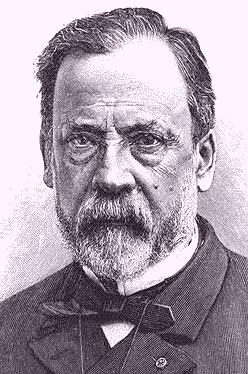
*Watson y H. Crick propusieron el modelo de doble hélice del ADN.

http://www.vi-e.cl/internas/sabias/leyes_mendel.htm
http://geologia.igeolcu.unam.mx/academia/Temas/RegistroFosil/evolucion.htm
http://www.portalplanetasedna.com.ar/mendel.htm
18.-QUÉ ES LA CLONACIÓN Y EN QUÉ CONSISTE?
19.-¿QUÉ EXPERIENCIAS EXISTEN SOBRE LA CLONACIÓN?
http://geologia.igeolcu.unam.mx/academia/Temas/RegistroFosil/evolucion.htm
http://www.portalplanetasedna.com.ar/mendel.htm
18.-QUÉ ES LA CLONACIÓN Y EN QUÉ CONSISTE?
19.-¿QUÉ EXPERIENCIAS EXISTEN SOBRE LA CLONACIÓN?
*Las primeras experiencias de clonación artificial tuvieron lugar en ranas, durante 1952. Robert Briggs y Thomas King desarrollaron un método de clonación, denominado de "transferencia nuclear", que había sido previamente propuesto por el científico alemán Hans Spemann en 1938. El modelo ideado era el siguiente: de un óvulo del organismo a clonar se extrae el núcleo, que es donde reside el material genético, en un proceso que se denomina "enucleación".
*De la ubre de la madre de Dolly (la llamada original en el dibujo), los científicos sacaron una célula, que contiene todo el material genético (ADN) de la oveja adulta.
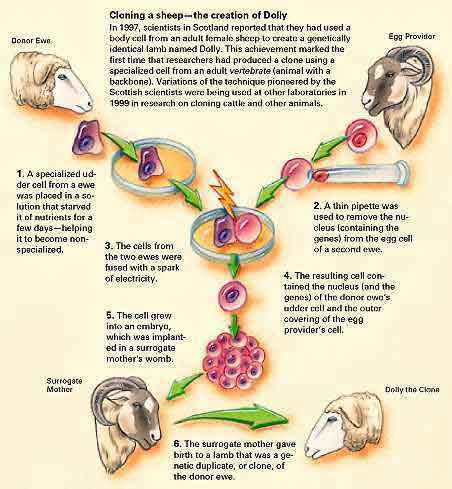
20.-CÓMO ES EL PROCESO DE LA CLONACIÓN
21.-¿QUÉ CONFLICTOS GENERA LA CLONACIÓN?
*La problemática de la falta de una estructura familiar natural que acarrearía la posibilidad de la clonación, tiene mucho que ver con la posición ontológica que uno toma como base al ponerse a analizar la situación.
Es decir, resulta necesario tomar una posición esencialista para considerar que una determinada estructura convencional resulta ser la estructura “correcta” que una familia debe tener.
Esta concepción tiene seria correlación con cuestiones de “fe”, en tanto desde las religiones, el catolicismo en el particular caso argentino, se forma conciencia acerca de cuál debe ser la estructura que una familia debe tener, siendo toda aquella que se conforme de manera diferente una desviación de lo que es correcto.
*Actualmente se genera conflictos morales y legales, actualmente (2001) en tratamiento en el congreso de los Estados Unidos.
Es decir, resulta necesario tomar una posición esencialista para considerar que una determinada estructura convencional resulta ser la estructura “correcta” que una familia debe tener.
Esta concepción tiene seria correlación con cuestiones de “fe”, en tanto desde las religiones, el catolicismo en el particular caso argentino, se forma conciencia acerca de cuál debe ser la estructura que una familia debe tener, siendo toda aquella que se conforme de manera diferente una desviación de lo que es correcto.
*Actualmente se genera conflictos morales y legales, actualmente (2001) en tratamiento en el congreso de los Estados Unidos.
*Presenta graves problemas pues supone la creación de un embrión cuyo desarrollo se paraliza para su uso médico o para la investigación; esta práctica es rechazada por las asociaciones y movimientos anti-abortistas y por aquellos que lo consideran una instrumentalización del ser humano.
http://alfinal.com/Temas/clonacion.shtml
http://alfinal.com/Temas/clonacion.shtml
A. - WHAT IS THE INHERITANCE?
* The set of phenotypic characters and genome an individual transmits to the offspring.
* Genetic transmission is normal or pathological character of the ascending to descending. The genetic constitution of an individual.
http://es.wikipedia.org/wiki/Herencia
http://omega.ilce.edu.mx:3000/sites/ciencia/volumen3/ciencia3/146/htm/sec_16.htm
http://enfenix.webcindario.com/biologia/genetica/conceptm.html
2.-WHAT IS THE GENETIC
* It is the part of biology that deals with inheritance and associated with it.
* It is the science that studies the characteristics that are inherited in humans, animals or plants.
* It is l, a science that studies the biological heritage, ie the transmission of morphological and physiological traits that pass from one living organism to its descendants.
http://buscon.rae.es/diccionario/drae.htm
usuarios.lycos.es/doliresa/index-21.html
www.portaley.com/biotecnologia/bio8.shtml
www.geocities.com / cienciayfe / glosario.html
3. - WHAT IS A GENE?
* Is a linear sequence of nucleotides in DNA or RNA which is essential for a specific function, either in the development or maintenance of normal physiological function. It is regarded as the storage unit and unit of heredity in transmitting this information to offspring.
* It is the essential physical and functional unit of heredity. A gene is an ordered sequence of nucleotides located at a particular position in a particular chromosome that encodes a specific functional product (as a protein or an RNA molecule).
http://es.wikipedia.org/wiki/Gen
http://usinfo.state.gov/journals/ites/0903/ijes/glossary.htm
http://whybiotech.com/mexico.asp?id=2713
http://www.fdc.org.co/glosario/glosario5.html
4. - WHAT IS A CHROMOSOME?
Are rod-shaped structures found in all cells of the body and contain all the information that determines the characteristics of the individual. Normal human cells contain 46 chromosomes.
http://www.spinabifidamoms.com/spanish/glossary.html
http://www.biologia.edu.ar/introduccion/4intro.htm
usinfo.state.gov/journals/ites/0903/ijes/glossary.htm
www.linfoma.info / linglosa.htm
5. - WHAT IS THE STRUCTURE OF DNA?
The structure of DNA consists of four nitrogenous bases of DNA are distributed along the "backbone" which comprise the sugars with phosphoric acid in a particular order. (DNA sequencing). Adenine (A) pairs with thymine (T), while cytosine (C) makes with guanine. The two DNA strands are matienen together by hydrogen bridges between the base.
http://www.efn.uncor.edu/dep/biologia/intrbiol/macromoleculas/adn.htm
http://www.arrakis.es/ ~ lluengo / adn.html
http://es.wikipedia.org/wiki/ADN # Design
http://www.biologia.edu.ar/adn/adnestructura.htm
6. - WHAT IS THE DIFFERENCE BETWEEN RNA and DNA?
Chemically
The RNA sugar molecule contains an oxygen atom is missing in the DNA.
RNA contains the base uracil in place of thymine in DNA.
Structurally:
The set of nucleotides used to construct polymers thereof, because DNA containing A, C, G and T, while RNA containing A, C, G and U
RNA is single stranded, bend as DNA.
DNA is the "master copy" of genetic information, which remains in "reserve" within the nucleus, whereas RNA is the "working copy" of genetic information. This RNA that carries instructions for the synthesis of proteins is called messenger RNA.
* Although it has much in common, RNA and DNA differences for several things, the most
are: the nucleotide conjutno, RNA is single stranded, and so on.
http://www.arrakis.es/ ~ lluengo / sintesisarn.html
http://cancerquest.org/printfriendly.cfm?printsec=8&lang=spanish
http://www.monografias.com/trabajos11/adna/adna.shtml
7.Influencia the environment in the manifestations of hereditary characteristics.
* Living things are influenced by the environment in which they live and develop. Any external stimulus provokes reactions in the body, an adaptive and others of rejection, which will influence your organization and its constitution.
From the moment of conception, each organism is influenced by the environment, and the expression of any gene is always the result of the interaction of the gene and the environment.
* In addition to these hereditary characters, there are differences due to external environmental factor which gives rise to variations.
http://www.monografias.com/trabajos10/heram/heram.shtml
http://www.datacraft.com.ar/salud/salud-personalidad.html
http://www.mundoagrario.unlp.edu.ar/nro3/Miranda.htm
http://www2.uah.es/sancho/quimica/Tema% 2015/TEMA% 2015.pdf
8.A called dihybrid cross and cross monohidrido.
Monohybrid crossing: Cross from individuals that differ with respect to the alleles at a locus bearing
individually, ie in a single feature
Dihybrid crossing: Crossing gene in which we consider the behavior of different pairs of genes.
http://www.doschivos.com/trabajos/biologia/129.htm
http://www.biologia.arizona.edu/human/activities/blackett2/str_inheritance.html
http://vida-enlaluna.blogspot.com
9.Explica the relationship between heredity and sex.
The inheritance is related to sex, occurs in those organisms where one sex has a pair of unequal heterocromosomas, such as the X and Y that are involved in sex determination. The chromosomes carrying these genes to encode for sex-linked characteristics.
In humans have identified several genes that are located in the heterocromosomas, and therefore it is sex-linked inheritance. For example, the gene coding for color blindness and hemophilia is located in the heterocromosoma X.
http://omega.ilce.edu.mx:3000/sites/ciencia/volumen3/ciencia3/125/htm/sec_3.htm
http://ejb.ucv.cl/gmunoz/genweb/genetica/frame/textos/9_3herencia_ligada_s.htm
http://www.elergonomista.com/biologia/genetica.htm
http://www.ucm.es/info/antilia/asignatura/practicas/trabajos_historia/genetica.htm
http://www.ucm.es/info/genetica/AVG/programas/Programas.htm
10.Herencia RH factor in the blood.
The Rh factor is inherited in the same way, except that there are two alleles and the RH is dominant. The disease is provcada RH RH by a mother who conceives a child-RH +. The antibodies of the mother's blood destroy the blood of the son.
Rh factors follow a common pattern of genetic inheritance. The Rh positive gene is dominant (stronger) and even when paired with an Rh negative gene, the positive prevails.
http://www.healthsystem.virginia.edu/UVAHealth/peds_hrnewborn_sp/bloodtyp.cfm
11.Comenta numerical chromosomal abnormalities.
* Those that involve the loss / gain of one or more whole chromosomes and may include both autosomes and sex chromosomes. Generally, the loss of chromosomes has greater impact on an individual gain, but it can also have serious consequences.
* Are you are one of the types of chromosomal abnormalities. These types of birth defects occur when a number of different chromosomes in the cells of the body than is normal.
http://www.healthsystem.virginia.edu/UVAHealth/peds_genetics_sp/numeric.cfm
http://www.virtual.unal.edu.co/cursos/ingenieria/2001832/lecciones/anomalias_cromosomicas.html
http://www2.uah.es/biomodel/citogene/dynacare/geninfo.htm
http://www.iqb.es/cromosomas/anomalias.htm
12.Comenta characters on X-linked disease
Chromosomes X and Y are the ones that determine sex. Normal women have two X chromosomes and males one X and one Y. A disorder caused by an abnormal gene on one X chromosome disorder called X-linked or sex-linked.
A seemingly normal mother with an abnormal gene on one of her X chromosomes has a probability of 50 percent (one in two) to transmit to his son.
http://www.nacersano.org/centro/9259_9704.asp
13. - WHAT IS THE HUMAN GENOME?
The set of genes of an organism, the genetic heritage stored in the set of their DNA or their chromosomes. It contains information not only of the main features inherited, but also on alterations and diseases that could suffer throughout our lives. By understanding and location of the genes may act on those responsible for diseases.
http://www.terra.es/cac/articulo/html/cac1718.htm
http://es.wikipedia.org/wiki/Genoma_humano
http://www.monografias.com/especiales/genoma/index.shtml
http://geosalud.com/Genoma% 20Humano/index.html
14.-HOW IT RELATES TO THE GENETIC HERITAGE
Heritage is related to genetics so that genetics tries to explain how inherited and modified the characteristics of living things, which may be of the form (the height of a plant, the color of their seeds, flower shape , etc..), physiological (eg, the formation of certain protein that performs a specific function within the body of an animal), and even behavior (in the form of courtship before mating in certain groups of birds, or mating the shape of mammals, etc.). Thus, genetics is to study how these characteristics are passed from parents to children, grandchildren, etc.., And why, in turn, vary from generation to generation.
http://omega.ilce.edu.mx:3000/sites/ciencia/volumen3/ciencia3/125/htm/sec_3.htm
http://www.biologia.edu.ar/genetica/index.htm
15. - HOW INVOLVED IN THE INHERITANCE OF MATHEMATICS?
Involved in knowing the number of characters in the transmicion genetics of one person to another and knowing an individual's genetic constitution.
http://www.molwick.com/tgecv.es/at1-962-leyesherencia.html
16.-CUÁLES ARE LAWS GOVERNING THE HERITAGE AND THE GENETIC AND
AUXILIARY SCIENCES ARE. Examples where it applies the law of inheritance.
http://www.biotech.bioetica.org/ap1.htm
http://manesweb.8k.com/9.htm
http://www.arrakis.es/ ~ lluengo / genemende.html # GlossPrimera
17. - WHO proposed the laws of inheritance?
* The laws of heredity Furon propustas and initiated by Gregor Mendel in 1865.
* Hugo de Vries, who in 1910 discovered the only way for nature to generate likely to inherit property.
* Louis Pasteur (1822-1895).
* Watson and H. Crick proposed the double helix model of DNA.
http://www.vi-e.cl/internas/sabias/leyes_mendel.htm
http://geologia.igeolcu.unam.mx/academia/Temas/RegistroFosil/evolucion.htm
http://www.portalplanetasedna.com.ar/mendel.htm
18.-CLONING AND WHAT IS THE WHAT IS?
19. - WHAT ARE EXPERIENCES ON CLONING?
* The first artificial cloning experiments on frogs took place during 1952. Robert Briggs and Thomas King developed a method of cloning, so-called "nuclear transfer", which had been previously proposed by the German scientist Hans Spemann in 1938. The model developed was: the body of a cloned egg is removed the nucleus, which is where the genetic material in a process called "enucleation".
* From the udder of the mother of Dolly (the original call in the drawing), the scientists took a cell, which contains all the genetic material (DNA) of the adult sheep.
http://www.portaley.com/biotecnologia/bio5.shtml
http://www.madrimasd.org/cienciaysociedad/ateneo/temascandentes/clonacion/default.asp
20.-HOW IS THE PROCESS OF CLONING
21. - CONFLICT WHAT CREATES THE CLONING?
* The problem of the lack of a natural family structure entail the possibility of cloning, has much to do with the ontological position that one takes as a basis to get to analyze the situation.
That is, it is necessary to take an essentialist position to consider a conventional structure determined the structure turns out to be "right" that a family should have.
This view has serious correlation with matters of "faith" in both religions, Catholicism in the particular case of Argentina, is a consciousness about what should be the structure that a family must have, with all that is under way different deviation from what is right.
* Currently generates moral and legal conflicts, currently (2001) in treatment in the United States Congress.
* It presents serious problems since it involves creating an embryo whose development is paralyzed for medical or research, this practice is rejected by the associations and anti-abortion movement and those who consider it a instrumentalization of human beings.
http://alfinal.com/Temas/clonacion.shtml
http://www.portaley.com/biotecnologia/bio5.shtml
http://www.bioetica.org/bioetica/mono11.html




